NOS · Negotiation Operating System
Last update: 2026.11.19 · Personal proof of concept, not publicly accessible
NOS (Negotiation Operating System) is a workspace for preparing, conducting and reviewing negotiations. It connects context analysis, mandate and meeting preparation, then uses what was learned in each meeting to update the next steps. A language model helps at every stage: it asks questions, structures the notes and challenges the plan. But the negotiator keeps control of every decision.
The method: ten stages
PREPARE / DECIDE / ACT / LEARNA structured process that adapts after every meeting.
- 0Define the caseClarify the case and your role.
- 1EnvironmentUnderstand actors and context.
- 2Iceberg & shared spaceExplore interests and common ground.
- 3Risks & vulnerabilitiesAssess risks and responses.
- 4MandateSet authority, limits and options.
- 5Meeting preparationPrepare the next meeting.
- 6Critical reviewChallenge the plan with a Red Team.
- 7DecisionChoose and confirm the next action.
- 8Meeting cyclesMeet, debrief and learn.
- 9ClosureRecord outcomes and lessons.
After each meeting, the work goes back to stage 5 to prepare the next one, until the case is ready to close.
Stage by stage
Everything starts with defining the case: who you represent, what you are asked to obtain, and what your own role is. NOS then maps the environment (actors, relationships, constraints) before going below the surface with the iceberg: positions, the reasons behind them, and the values that hold them together. Where the icebergs of both sides meet lies the shared space to build on.
The preparation ends with risks and vulnerabilities, both for the negotiation and for the people involved, each with a possible response.
The mandate sets what can be agreed, by whom, and where the limits are. Only then is the meeting prepared: objectives, arguments, questions and fallback options in a brief.
Before deciding, a Red Team looks for the weak points of that brief. The brief is revised if needed, and then the negotiator decides on the next action.
Each meeting cycle (MC-001, MC-002…) records what happened and what was learned. If another meeting is needed, the work goes back to the meeting brief (stage 5), so the next meeting starts from the latest picture and not from the first one.
When the case is ready, closure records the outcome and the lessons worth keeping for the next negotiation.
Preparing a negotiation with NOS
The screens below come from a fictional training case; names have been changed. Click to enlarge.
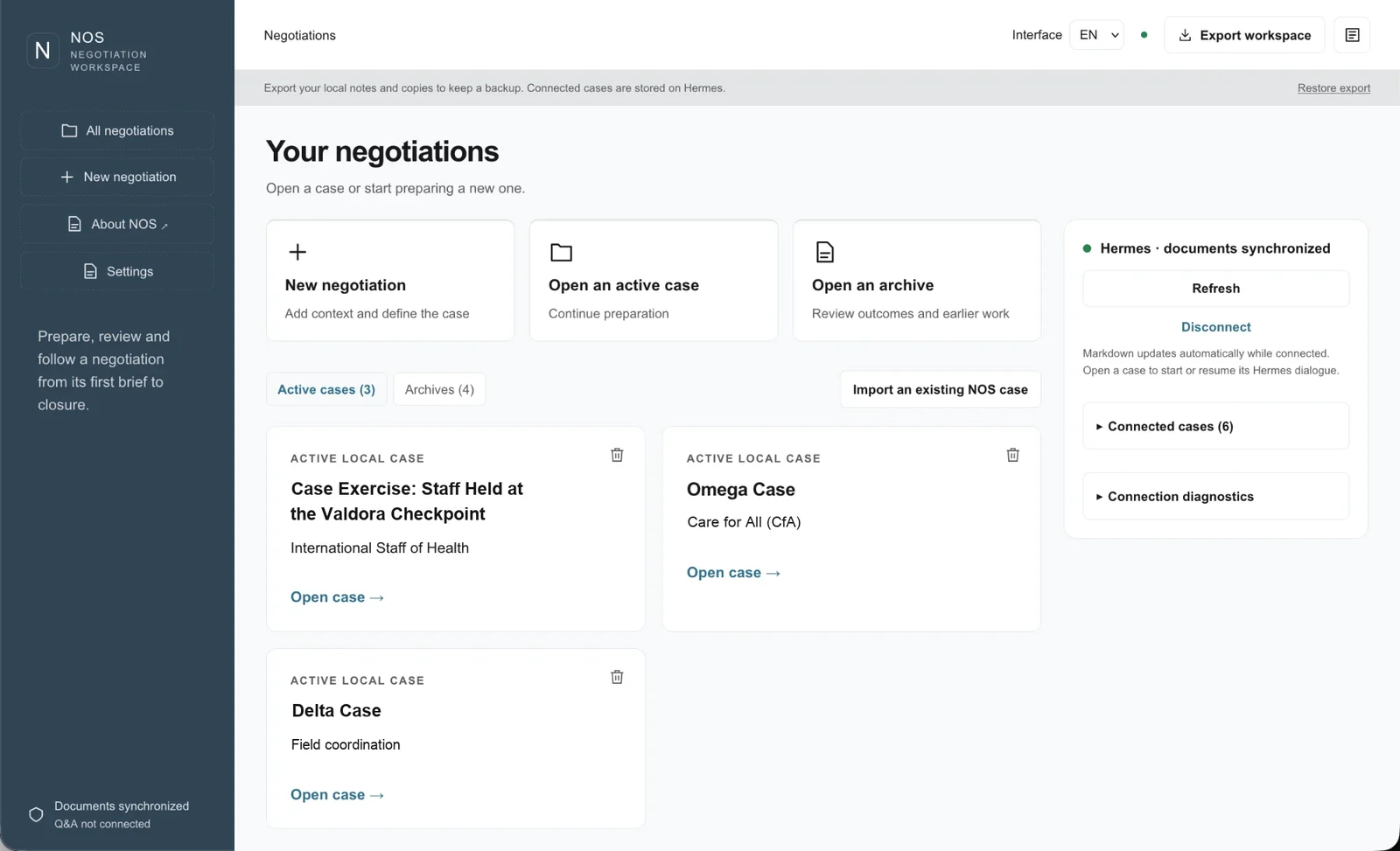
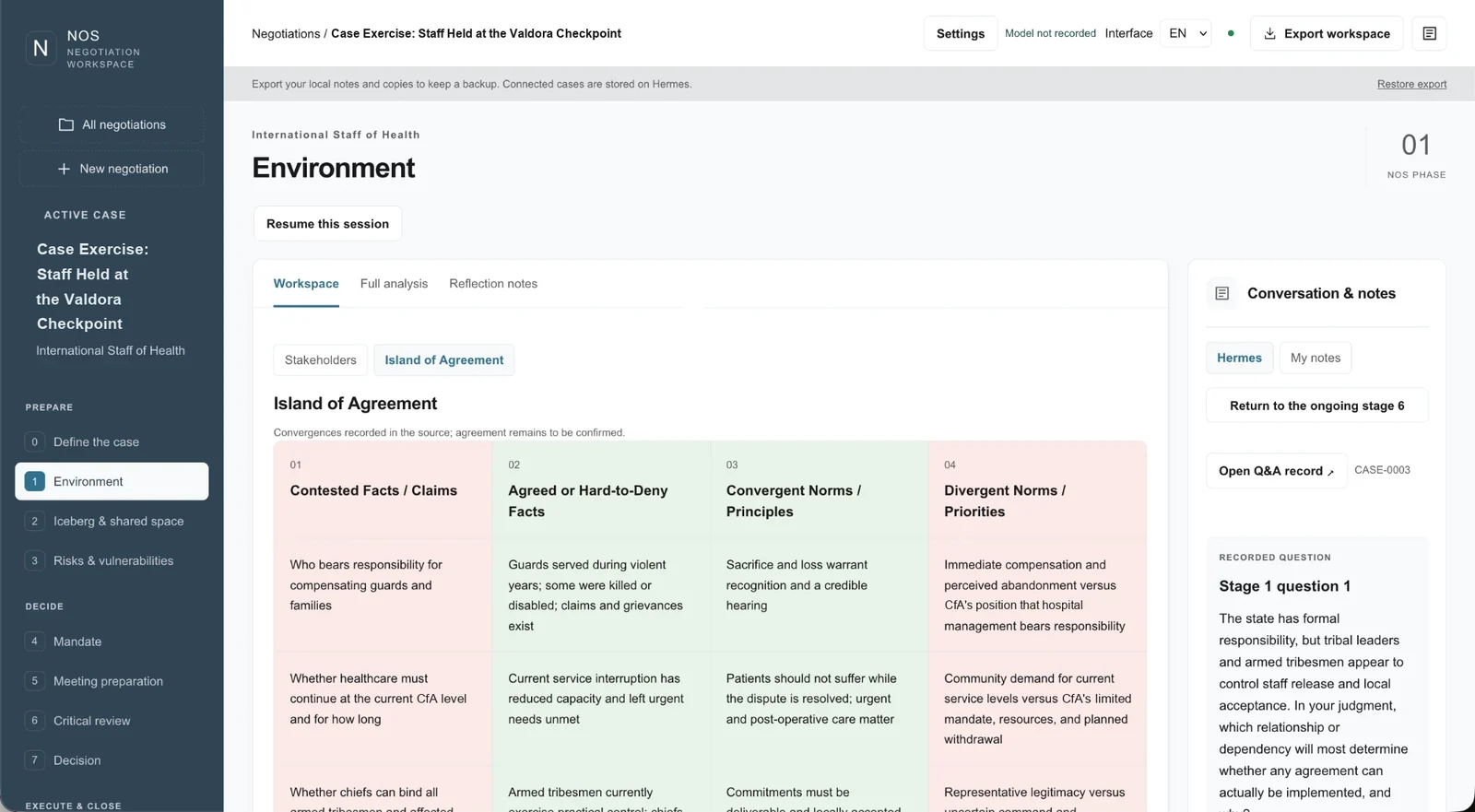
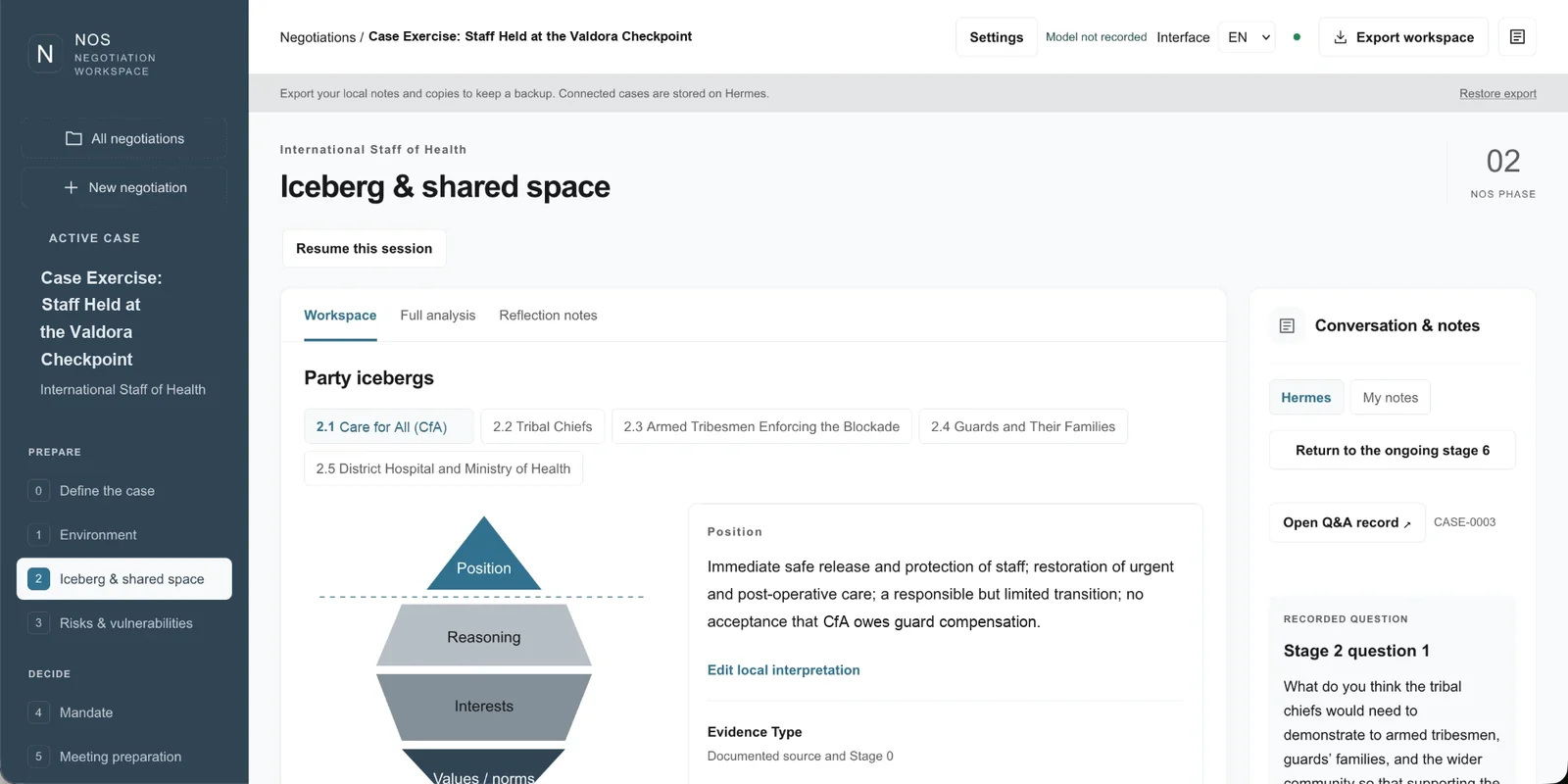
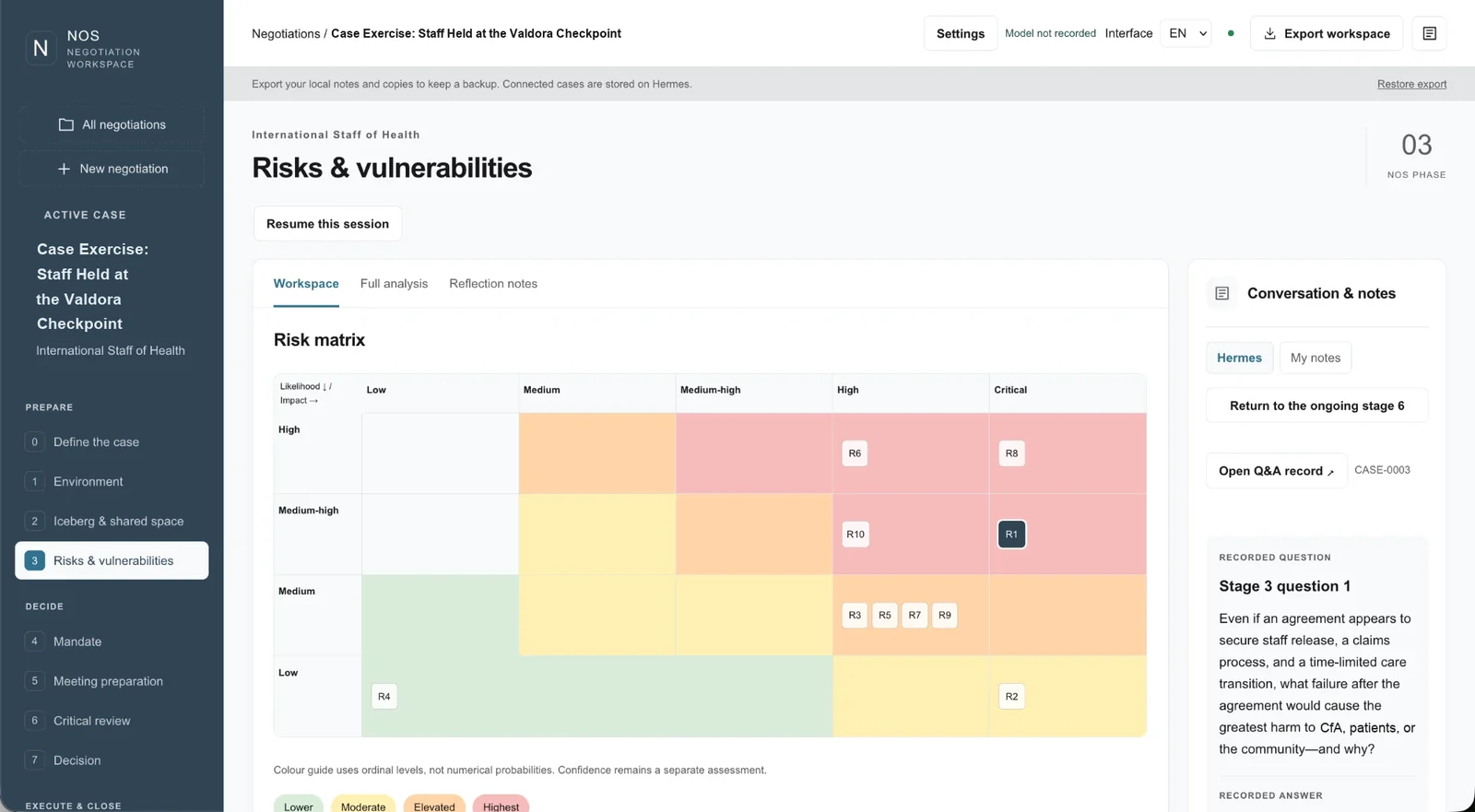
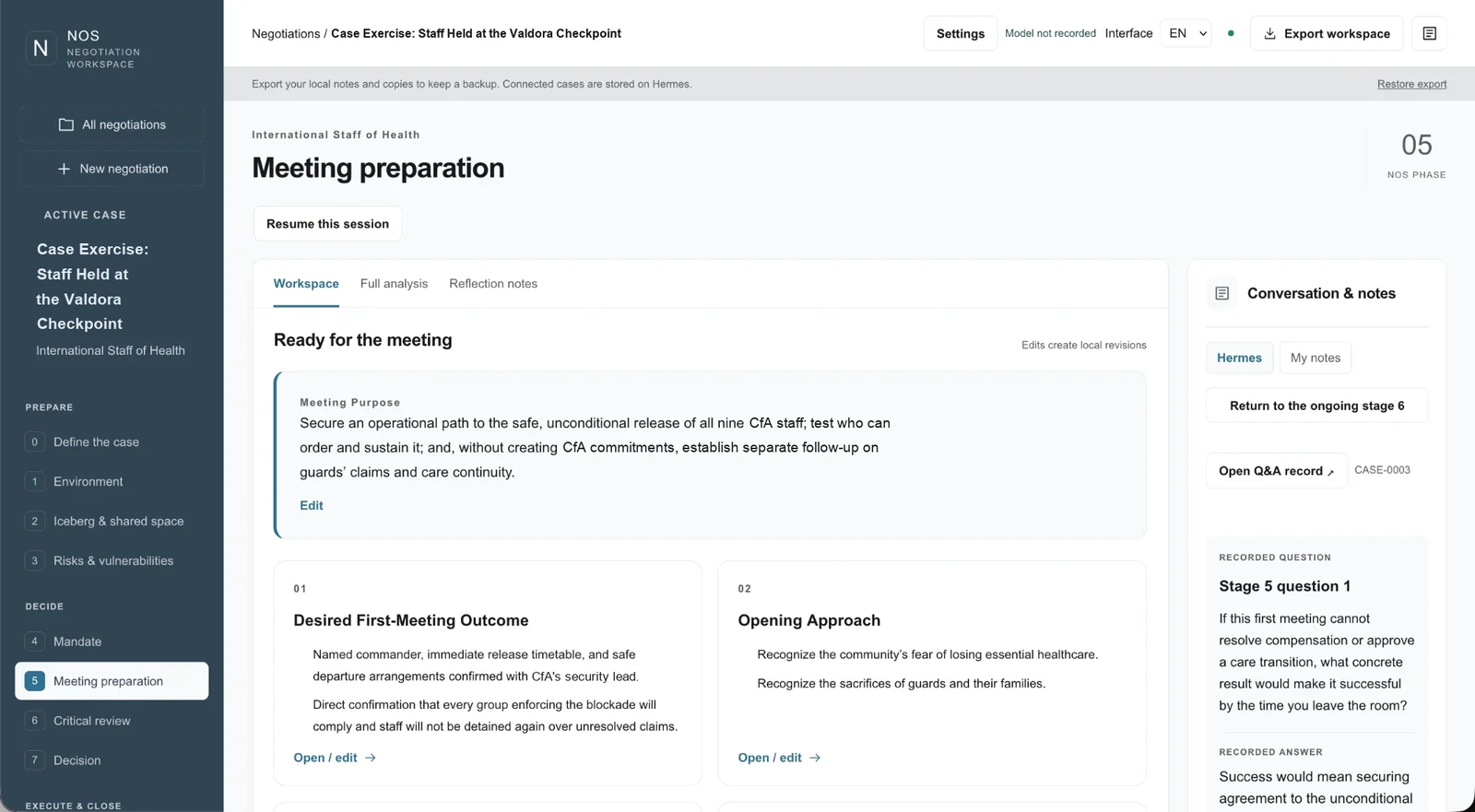
On the right of every stage, the conversation with Hermes: each question and answer is recorded, stage by stage.
In practice, the assistant works alongside the negotiator in each stage:
- Guided questions to frame the case: who you represent, your role, what is at stake.
- Structured analysis of actors, interests and positions (iceberg), and the shared space between parties.
- Risk mapping of the negotiation and of the people involved, with possible responses.
- A mandate with authority, limits and options, agreed before any meeting is prepared.
- A meeting brief, then a critical review by a Red Team that looks for weak points.
- Conversation and notes side by side, and a Q&A record that keeps track of what was asked and answered.
- A debrief after each meeting that feeds the next cycle.
- Export of the workspace at any time.
Settings
Choosing the language model
NOS talks to language models through an API. It can be connected directly to a provider account, for example OpenAI, Anthropic or Google, or to a service that gives access to many providers at once.
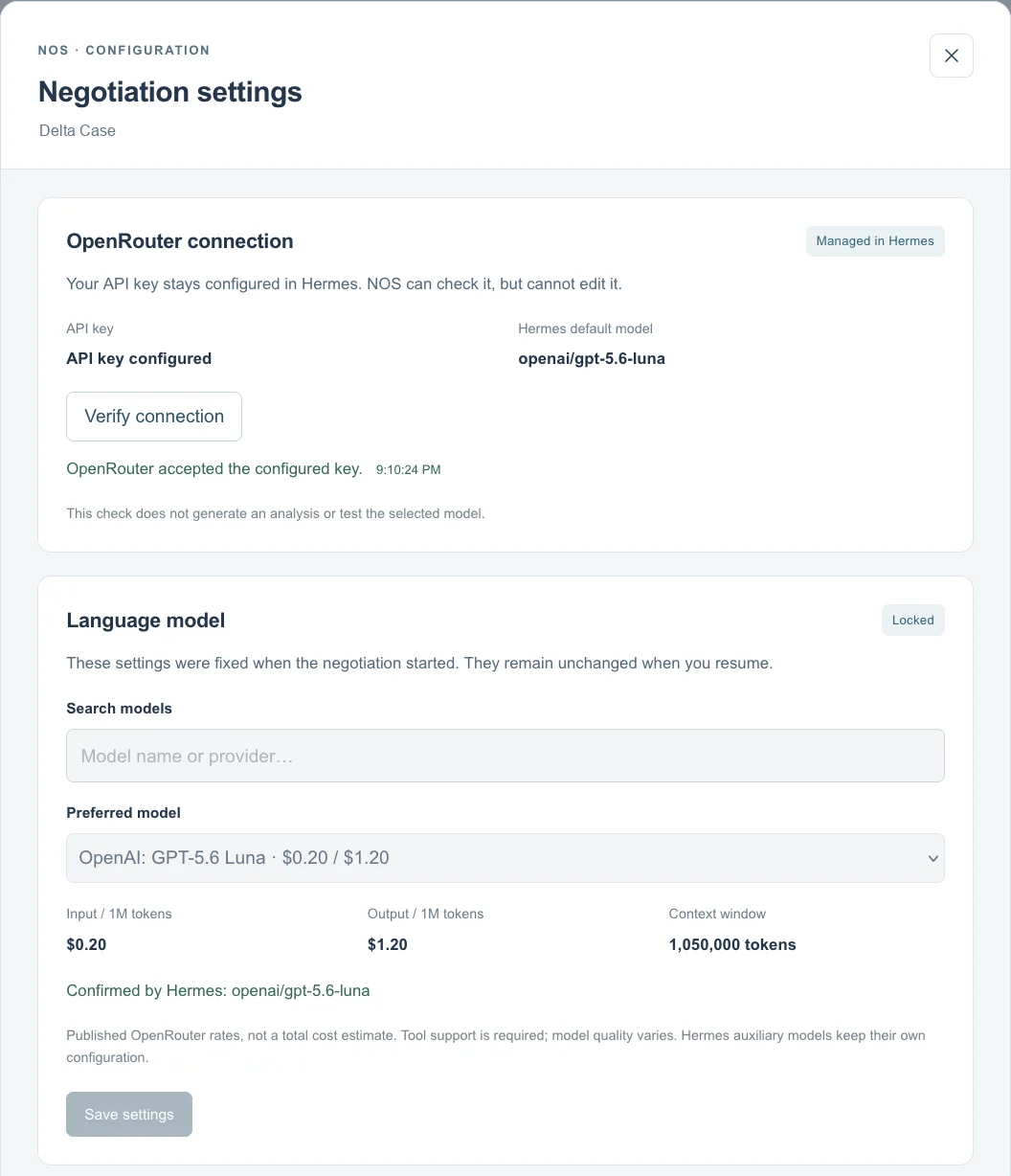
I chose OpenRouter: a single account opens a wide range of models, at very different prices. The difference matters. For the same session, a top-tier model such as OpenAI: GPT-5.6 Sol can cost several tens of dollars or euros, while OpenAI: GPT-5.6 Luna costs “only” a few. NOS therefore shows the published price per million input and output tokens, and the context window, before the model is confirmed.
The API key itself stays configured in Hermes: NOS can check that the connection works, but cannot read or change the key.
Once a negotiation has started, the model is locked: it stays the same when the work is resumed, so that all documents of one case are produced consistently and remain traceable.
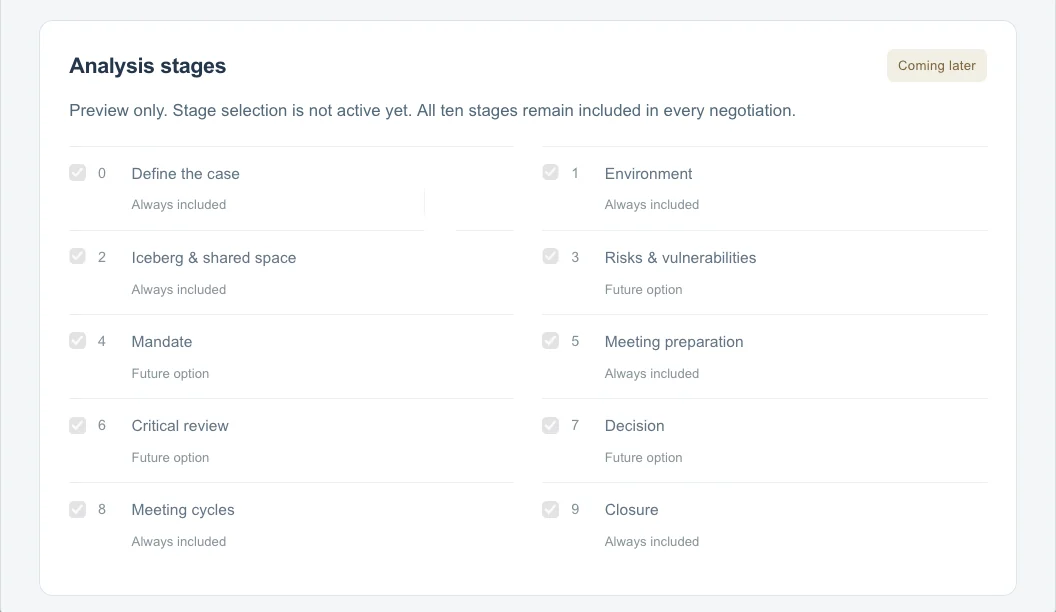
Choosing the stages In development
Not every negotiation needs the full path. The idea is to let the negotiator switch some analysis stages on or off when a case starts, for example for a short negotiation on a familiar topic. For now this is only a preview: all ten stages remain included in every negotiation. It will come if I find the time to build it properly.
Architecture
NOS runs on a small remote server at DigitalOcean, for a few dollars a month. That is a matter of convenience: any machine that stays on would do, including an old computer at home. The server is not exposed to the internet; I reach it through a private Tailscale network.
On that server, NOS relies on Hermes Agent, an open-source AI agent, organised with skills: one skill per stage, and an orchestrator (the negotiation coordinator) that follows the method, opens the right stage and keeps the documents in order. The language models themselves are called through OpenRouter.
private
HTTPS
In Hermes Agent, a skill is a set of written instructions that tells the AI how to do one specific task. NOS uses two kinds of skills:
Knows the whole method. It follows the case from start to end, checks where the negotiation stands and calls the right stage skill. It never skips a step without the negotiator's decision.
Each one does the work of its stage: the questions to ask, the analysis to make and the document to write. For example, the Red Team skill reviews the meeting brief and lists its weak points.
Status
NOS is a proof of concept rather than a finished product. I work on it in my free time, out of personal interest and without any pretension: to test what AI can bring to the preparation of a negotiation, and where it should stop. It works, I use it, and I keep improving it. A public demo is not available yet.
Roadmap. NOS is still in development and evolves little by little, depending on the time I can give it.